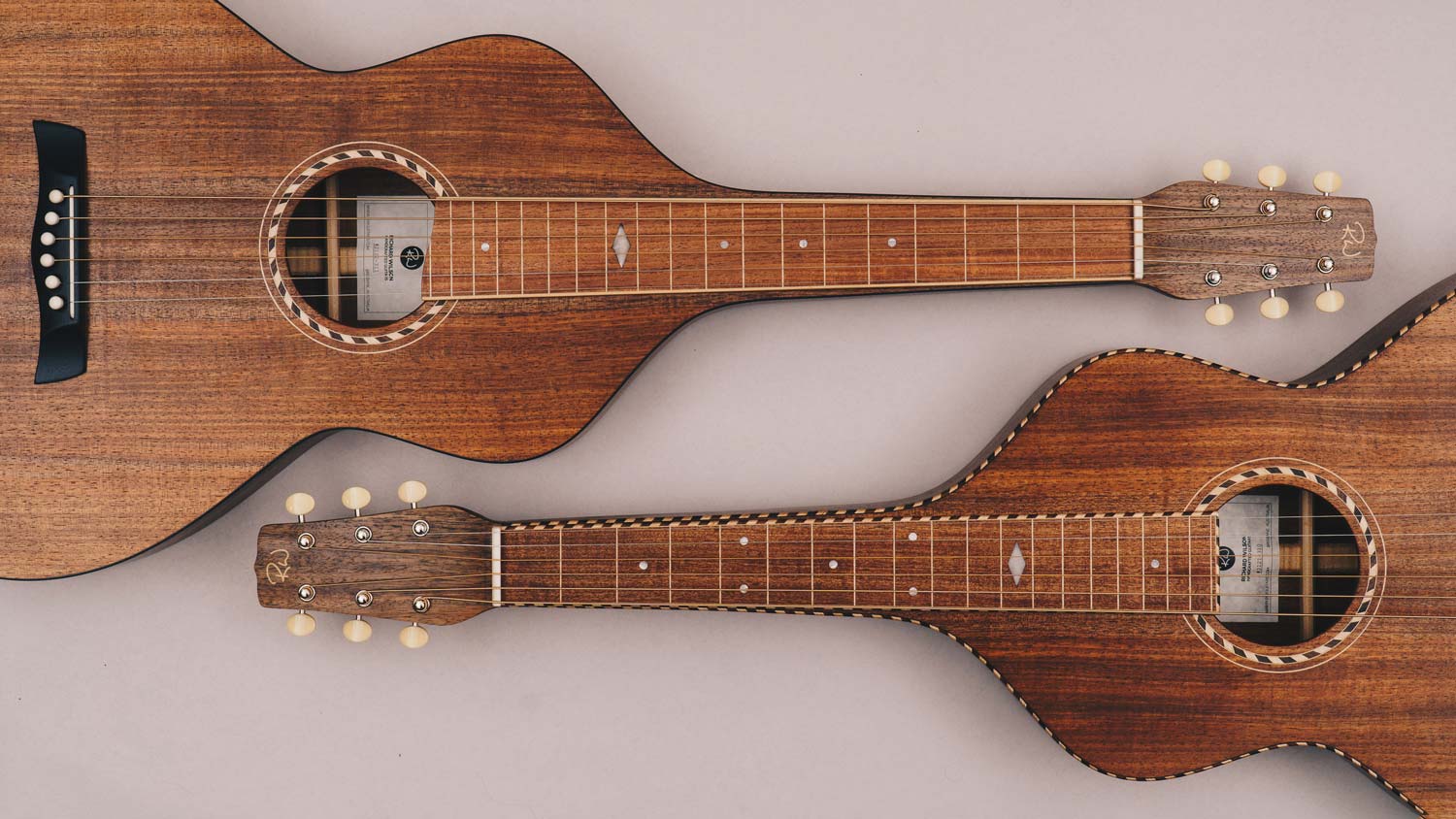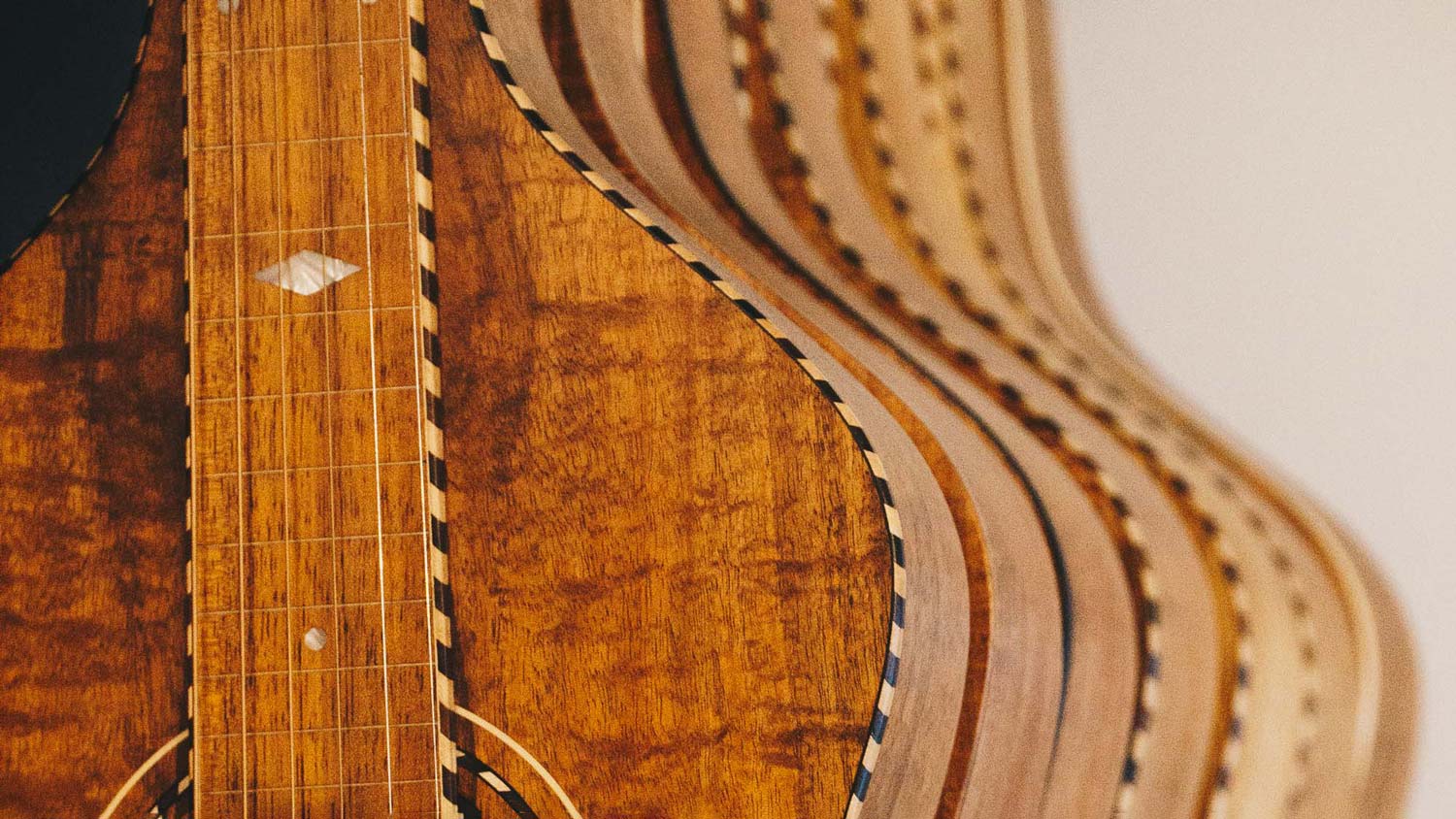


All instruments are individually crafted in a humidity-controlled environment that ensures all components are stable during assembly.
Guitars are sold without pickups; a range of pickups can be installed. Listed below are the most common options. Many slide players elect to install two or more pickups -- all the pickups listed below can be installed in tandem with separate output jacks.
Fishman Rare Earth
Magnetic soundhole-mounted pickups are among the most popular for many slide players, popularised by players such as Ben Harper and Jeff Lang. My preferred magnetic pickup is the Fishman Rare Earth humbucking pickup for its brilliant warmth and low-key design. It features an onboard preamp, volume control and a 1/4" output jack (located in the tail end of the guitar). Price: $350 (incl. installation).
Fishman Matrix Infinity
For a more traditional acoustic pickup, a Fishman Matrix Infinity can be installed. It features an undersaddle transducer, offering outstanding note clarity. Features a 1/4" output jack with onboard preamp, and a soundhole-mounted volume control. Price: $350 (incl. installation).
L.R. Baggs iBeam Active
The award-winning L.R. Baggs iBeam Active bridge plate transducer is among the most faithful acoustic pickups available on the market, without the normal sticky 'quack' sound offered by piezo pickups. Features a 1/4" output jack with onboard preamp, and a soundhole-mounted volume control. Price: $350 (incl. installation).
Other pickups can be installed -- contact for a specific quote.
In addition to the standard Tasmanian Blackwood and Koa, there are many native and imported timbers available, as well as a range of soundboard woods.
Contact me if you'd like more information about alternative tonewoods.
As standard, all guitars are finished with a satin pre-catalysed lacquer. This finish adds a richness to the appearance of the instrument, bringing out the natural beauty of the woods.
For an additional charge of AUD$500, any custom guitar can be finished with a gloss lacquer. Such a finish will generally add a minimum of four weeks onto the expected completion date, due to the necessary periods of levelling, respraying, buffing and curing that aren't required for the standard satin finishes.
The Model V (Classic) is finished with a full gloss lacquer as standard.
The Weissenborn's creation is largely owing to a Hawaiian music boom in the early 20th Century. Hermann Weissenborn, a German immigrant to New York who originally worked building and repairing violins and pianos before moving to Los Angeles and focusing on building guitars.
It is Weissenborn's Style 1-4 instruments made from Hawaiian Koa that have led to Weissenborn's name becoming synonymous with the iconic hollow neck lap steel.

The Weissenborn is known for its 'hourglass' or 'teardrop' body shape, tapered neck and 'fretboard' with flush markers. Its deep rich tone and booming volume are owing to its hollow neck design that extends the acoustic chamber the length of the body and its stiff Koa that offers amazing sustain and warmth.
The Weissenborn's resurgence in recent years is owing largely to its beautiful tone that has seen it become the instrument of choice for players like Ben Harper.
There are a wide range of different styles of bindings available on my guitars. What is listed below is only a sample of what is available. If there is a particular style you are interested in that is not featured here, feel free to contact me as more often than not it can be achieved.
Contact me to talk about the options you have in mind. When you are ready to go ahead I will send you an invoice for the order. A 50% deposit is required to secure a spot in the waiting list; balance is due upon completion, plus postage/shipping costs.
A 5% discount is offered for guitars which are paid in full up front. Postage/shipping costs aren't paid until completion of the guitar.
Model II features an ABS plastic binding similar to that found on many guitars on the market. This binding is available in black, white or cream. To the human eye these bindings have the effect of contrasting with the tonewoods used on the body to make it appear lighter or darker. For a darker looking instrument, black is the ideal look while white binding will tend to lighten its appearance. Cream tends to lighten while bringing out the reds from the body.
The binding schemes available for Model III and IV are identical and are virtually unlimited -- what is listed below is only a small snapshop of what can be achieved based on some of the designs used on past guitars. Please note some of these options are extra cost. Model III and IV guitars can also be built with any of the binding appointments from the Model I and II -- an ideal option if seeking the higher grade of timber and hardware used for these models.
Maple tends to be the most popular timber binding but there is an almost limitless range of possibilites including Ebony (black), or Blackwood/Koa for a natural look.
All styles can be matched with a corresponding rosette style.
Standard Maple binding
The simplest look to go with, the top and back edges of the guitar feature Maple binding.
Black/White fibre purfling
To add a bit of definition to the
binding, thin strips of black/white, or black/white/black fibre are inlayed on the inside edge of the binding (top only or top and back). These can also be included on the guitar's sides, in conjunction with a top purfling of any description.
Herringbone purfling
Featuring a herringbone pattern that is inlayed on the inside edge of the binding on the soundboard of the guitar. The optional addition of an inner maple strip provides an attractive separation between the purfling pattern and the soundboard.
Abalone purfling
Genuine abalone shell delicately shaped around the top edge of the guitar in conjunction with a solid wood binding.
Rope binding
A traditional appointment on original Weissenborns, this unique style of marquetry combines alternating strips of Maple and Indian Rosewood cut at an angle giving a unique appearance that resembles rope.
Blackwood binding
Tasmanian Blackwood binding can be installed successfully in conjunction with alternative body tonewoods, or on a Blackwood guitar for a very low-key look. When installed on a Blackwood body it looks great in conjunction with any of the above styles of purfling. Koa binding can be installed on Model IV.